
Shifting the Cattle
Mary R. Finnegan

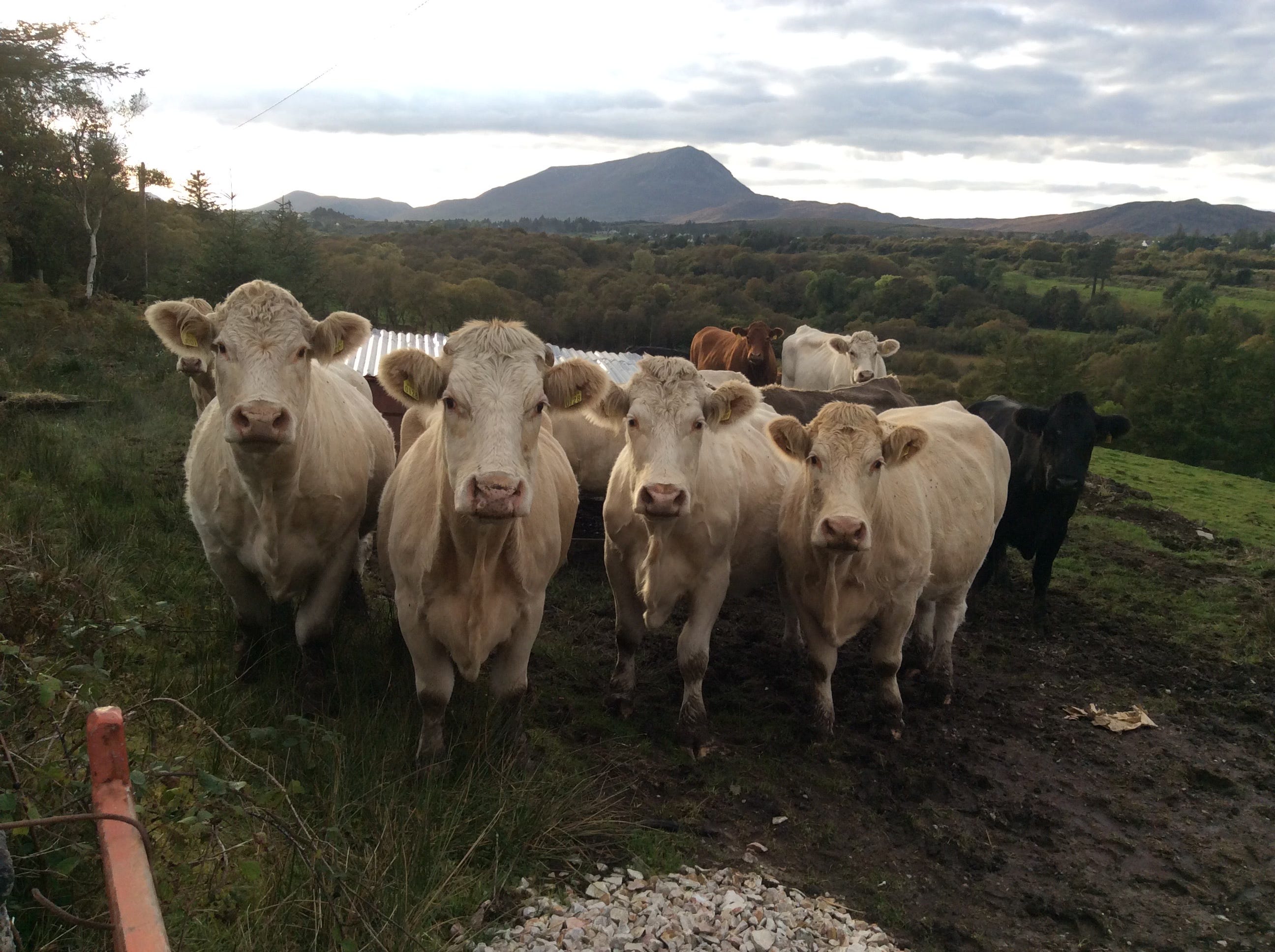
Shifting the Cattle
I’m only ten and though I hardly know
a thing about cows, Granny sends me off
to help my uncle when he shifts the cattle.
I put a sweater on. The new dress bought
at the thrift store before this trip is all
I want to wear, but each time I run down
with it on, Granny sends me up to change.
At home, it’s hot and humid, but here dawn
comes fogged, the windows frosted with gray dew
and damp air seeping through my summer clothes.
In this place where it seems to rain each day
and nothing ever dries, I wear what’s sent
from cousins, wellies from a woman down
the lane who saw me in my floppy sandals.
She walked through Granny’s back door without knocking
and blessed herself, then stood by the door, scanning
the room the way a lifeguard scans the ocean.
After an hour of drinking tea and chatting,
she said she’d pop out to the car, be back
in just a tick. Dropping a pair of boots
next to the door, she claimed she had no need
for them. Too old, she was, to work the farm.
Your young one there, she said to Granny, Grainne,
that’s what you call her. Wile tall that one is,
She’ll fit these well and they her. Nothing but
the dirty weather, sure, since they’ve arrived,
a drop of sunshine would be very welcome.
Then whispering in my ear, she said, we hate
the rain, but it’s what brings us all this green.
    It’s like a crayon box that has one color
in many strange hues, iridescent green
after a storm to dull as an old shirt.
On cloudy days, the fields gleam bright and eerie
as a cat’s eyes. Fields, bushes, trees all seem
to have their own green shade. It makes me dizzy.
The waves rise up to smash against the cliffs.
When I lean over the edge, I’m soaked.
The distance to the water seems alive,
as if it might reach up and pull me down.
The sky here hangs so low I feel I could
reach out and brush my hand along the blue
velvety length of it, my fingers looping
through the thick, curly clouds. Before a storm,
the sky is black as a bruise, afterwards,
a constellation of orange, crimson, purple.
    Now, come with me, wee Yank, my uncle says,
and shoos me out the door. It’s nearly night,
though there is hardly any darkness outside,
only a dimmer brightness than the day,
a brightness even the rain can’t seem to dampen.
The sun, hovering at the horizon,
won’t set until almost one in the morning.
It looks as if the world has been washed clean,
the way it does in dreams, real and not real
at once. I am unnerved by how the light
glows shimmery gold, and how the weather changes
from rain to sun to rain and back again,
and the way Granny took the lovely goose
and killed it. I thought we were going to
the shops when she said, Right so, we’ll get our dinner.
    Uncle and I walk side by side. He points
across the lough to the abandoned castle
we visited, thick stones glinting in the sunshine.
The castle has no roof, no doors. Its windows,
missing their glass, look like eye sockets, empty
and black. Inside the castle, birds have built nests
high up in small alcoves and corner ledges.
My uncle held me up to have a look.
The twists of twigs, grass, paper, broken shells
all fit together, though I can’t see how.
    I want to ask about the drive from Dublin,
the posters of young men that hung from lampposts,
his silence as we crossed into the north.
Sure, mind yourself, said my aunt, we’ve the Yanks.
The British soldiers stopped us, yelling, Out!
We stood around the car in pouring rain.
Three soldiers watched us while the others checked
the car, the luggage—even mine. One held
a mirror on a stick to look beneath
the car. I heard them talking as they pointed:
Who knows, said one, what they’d do even with
a child in the car. I wasn’t scared,
because I had the sleep of a long journey
still upon me so it was more like dreaming.
Later, my uncle slammed his fist against
the steering wheel and said, what they’d do even
with the wee wee’un in the car, the bastards.
    Beside my uncle now, I try to glean
the meaning of “to shift the cattle.” Shift?
To move? But how? I’m only small, no help
with moving big things. Clouds rise over Muckish,
its flat top like a table. Uncle pulls
open the gate. The cows moo, lumber passed
and out into the lane. I cannot move.
Someone has given me a stick. I watch.
The man who helps my uncle is here now.
I do not understand a word he says.
Most of his teeth are gone so that his mouth
looks like the old well, black and deep, I keep
away from him as Granny told me to.
    Uncle says buried bog-deep, there is treasure,
silver and gold, thick slabs of butter, fresh
enough to eat, and deeper still the stories.
Cow rumps sashay from side to side as plats
plop from their backsides right onto the road
where we are walking. Laughing as I jump
around them makes me think of playing hopscotch.
Sheep baa and scutter for the cows, but not
for me. I hop away. My uncle swats
with a stick longer than the scar that runs
in a white crooked line down Daddy’s belly.
We say the rosary for him every night
and Granny gave him Garten clay to keep
him safe from drowning and from sudden death.
When people see him out at Mass or walking
along the road, they say, How are you keeping?
You’re looking well. I want to tell them that
he’s better now, he swings me on his arm
and carries heavy rocks from field to field.
He can still cut turf. He is strong and well.
    We pass the lough. A heron dips her head
into the water, lifts it up, a fish
held in her beak, its scales, catching the sun,
sparkle bright colors. Spreading out her wings,
the heron flies away. I have forgotten
about the cows, now in the field across
from the abandoned castle. Uncle shuts
the gate. The midges bite my face and arms
and settle in my hair. The cows come over
to stare at me with watery, sad, brown eyes,
chewing the grass, their mouths as big as engines.
Black bricks of turf are drying near the bog
and you can smell the sharp scent on the breeze.
We pass the well, I lean to look inside
at its green mossy dark and think of falling,
then Uncle pulls me back, away from there.
    At home, we drink more tea, more tea, more tea.
Mam said to take what I am given so
I drink the tea though I am very tired.
We say our prayers, then Granny calls me out,
points at a greenish bush that shines across
from the far field where we’ve just left the cattle.
Stay far away from that. The fairies snatch
wee’uns from there. She turns and goes back inside,
falls straight away into prayer’s steady murmur.
Still outside, I can hear the nightbirds singing,
and think I see the cattle with their big,
brown eyes, mouths moving, and I see green lights
flashing the way a mirror does in sunshine.
The midge bites itch. I want to scratch the welts
blotching my skin, though I know I should not.
Clouds hide the moon. The black sky opens wide,
as if the light has dropped into a well.
Bog stones glint silver and gold as fish scales,
and this whole world is an abandoned castle,
and this farm is its little alcove shrine.
Mary R. Finnegan is a writer and editor from Philadelphia. She earned a BA in English from the Pennsylvania State University, a BSN in Nursing from Thomas Jefferson University, and an MFA in Creative Writing from the University of St. Thomas, Houston. She is the Co-Social Media Editor at Dappled Things and Deputy Editor at Wiseblood Books. Her work has appeared in Lydwine, New Verse Review, American Journal of Nursing, and elsewhere. Today is her birthday and that is why Anthony and Luma published this poem.
Poet’s Note
Of childhood memories, Flannery O’Connor said: The fact is that anybody who has survived his childhood has enough information about life to last him the rest of his days. If you can’t make something out of a little experience, you probably won’t be able to make it out of a lot.
This poem, like many others I’ve written, weaves memories of a trip to Ireland with imagination. My mother’s family is from Donegal, which is in the Northwest corner of the country. To get there from Dublin, back when I was a child, meant driving through Northern Ireland (the North). The Troubles were in full force then and I remember waking to soldiers ordering us out of the car; I remember signs with pictures of Bobby Sands and the other hunger strikers. My granny really did kill that lovely goose for dinner. Cows do plop their plats right on the road as they walk. Those three weeks were filled with experiences I didn’t quite understand, things beyond the ken of a child. I think that lack of understanding is why many of the moments are still as alive as if they’d just happened and why I keep writing about them, making up details to fill in the blanks in order to achieve the emotional complexity of that experience.
Before learning to write formal verse, I was always grasping to write about those three weeks in Ireland, never quite saying what needed saying, and so learning to write in blank verse was a revelation. The versatility of iambic pentameter allows a poet to do just about anything. “Shifting the Cattle” is one of my earlier attempts at blank verse, the first draft written (lucky me!) while I was in the MFA program at UST, under the tutelage of the great poet James Matthew Wilson. There was a lot of revision, based on suggestions from James and my classmates, and then more revisions from my thesis advisor, the great Ryan Wilson (lucky me, again). And then, more revisions after the great Steve Knepper read it (lucky me, again, again!), and then more revisions as I attempted to record it. Anthony and Luma, both very insightful readers, also shared their thoughts, helping me to see that some revisions were not for the better. I am grateful to all of them.
Anthony’s Note
As happens often with Mary’s poetry, “Shifting the Cattle” leaves one comforted. The blunt innocence of this child’s pilgrimage through rain, mud, and turf, those things concrete and tactile, are through the poet’s words uplifted into the numinous where we encounter the mystical connections between land, cattle, family, and history.
The poem has this effect perhaps because, for many of us, there is scarce room in life for the contemplation of Otto’s mysterium tremendum et fascinanss (the English cognates give a good idea of Otto’s meaning) or to use Virgil’s words, the “tears in things”.
Faithful to a child’s voice, the images in the poem are plain-spoken but luminous, contemplative but not sentimental:
—“the sky is black as a bruise”
—“the cows come over to stare at me with watery, sad, brown eyes”.
The many shades of green described in the poem recall Petrarch’s verde etate, the green age of youth, soon lost, which for the child is literal and spiritual at once.
I believe the reader will find, as did I, that the encounter with “Shifting the Cattle” is as much an act of remembrance as it is of reading, a recollection of the duties of memory and inheritance, of the goodness, grief, and grace of life immediately lived. Thus the rain, the rosary, the cattle, granny’s stoic tenderness, the uncle pointing at the ruins all lead to the striking spiritual intimation: “this whole world is an abandoned castle / and this farm is its little alcove shrine.”
This is for us not so much an observation but a revelation, a calling to the duties of pietas: devotion and loyalty to land, family, ancestors, posterity, and God.
 | A guest post by
|
Such a good poem! "It’s like a crayon box that has one color / in many strange hues"
Happy birthday, Mary!
This is lovely in every way.